
LED strips and fire
Addressable LED strips are the quickest way to make a prop look alive: glowing eyes, a lantern that flickers, a cauldron that bubbles green.
Which strip?
Section titled “Which strip?”| Strip | Wires to the board | Console function |
|---|---|---|
| WS2812B (often sold as “NeoPixel”) | one data wire | LED strip (WS2812) |
| SK9822 or APA102 (“DotStar”) | data and clock | LED strip (SK9822 / APA102, clocked) |
Either kind works. WS2812 is cheaper and easier to find. The clocked kind is more forgiving about timing and long wires. Each board page says how many strips it can run. The DevKit V1 can run up to 8 WS2812 strips.
Wiring
Section titled “Wiring”Power supply 5V ─────────────── strip 5VPower supply GND ──┬─────────── strip GND └─────────── board GNDBoard pin ── level shifter ──── strip DIN (and CLK for a clocked strip)- Power the strip from its own 5 V supply, not from the board. A pixel at full white draws about 60 mA, so 30 pixels can want nearly 2 A. That is far more than a USB port or the board’s regulator can give.
- Join the grounds. The supply’s GND, the strip’s GND and the board’s GND all connect together. A strip that flickers at random very often has a missing ground.
- Use a level shifter on the data line. The board’s signal is 3.3 V and a 5 V strip expects close to 5 V. It often works without one, until the night is cold or the wire is long, and then it flickers. A 74AHCT125 (or the one-channel 74AHCT1G125) fixes it for under a dollar.
Setting it up in the console
Section titled “Setting it up in the console”Assign the pin to LED strip (WS2812) and set:
- pixels: how many LEDs are on the strip (up to 300).
- order: the color order. Try GRB first, which most WS2812 strips use. If red shows up as green, switch to RGB.
- effect: solid color or fire.
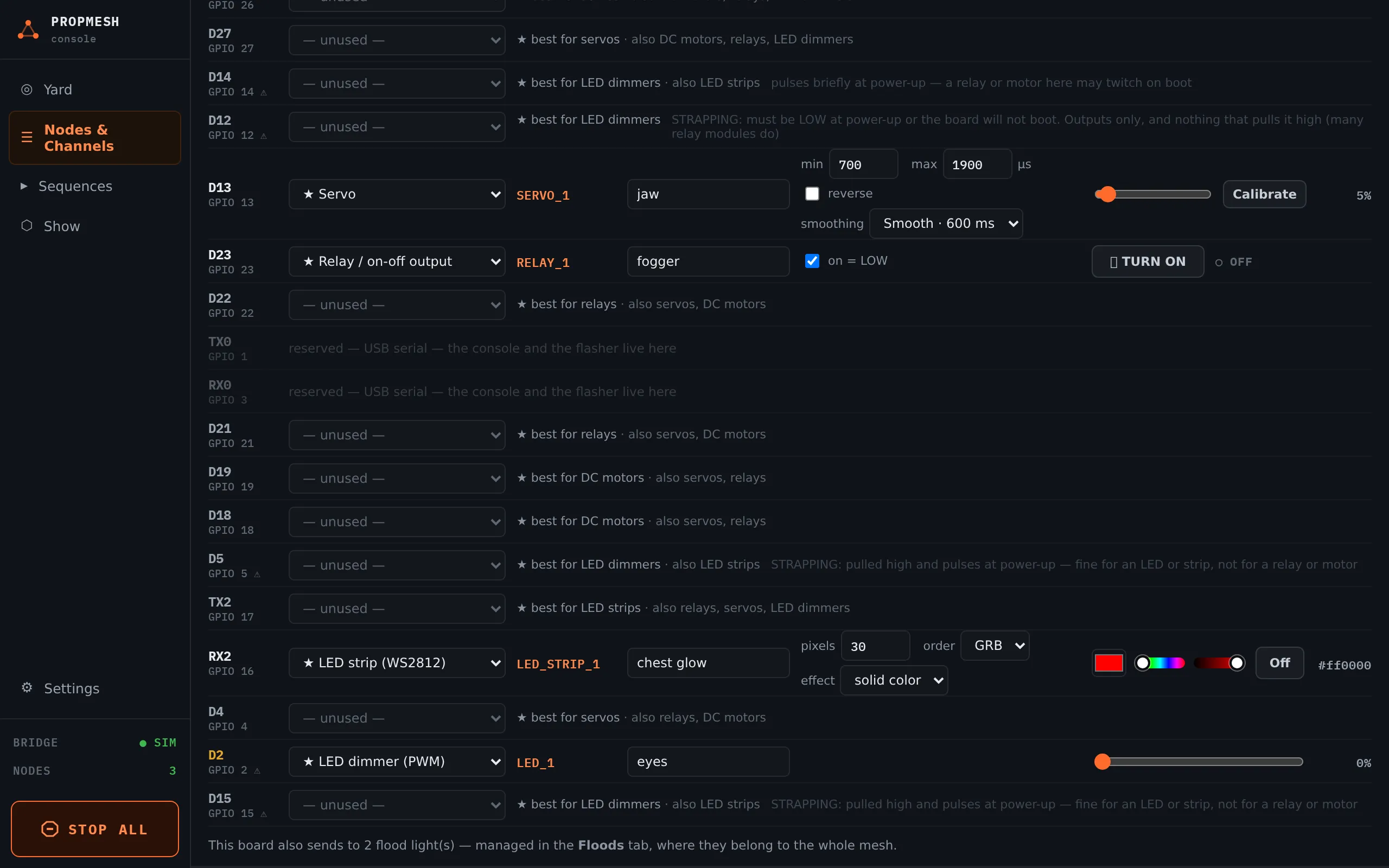
Save to node, then use the color picker in the TEST column. In a sequence, a solid strip takes any color, and Off turns it dark.
The fire effect
Section titled “The fire effect”Set effect to fire for a flame that never repeats. It suits lanterns, jack-o’-lanterns and torches. The FIRE settings shape it:
| Setting | What it changes |
|---|---|
| columns, height, zigzag | how your strip is arranged. A single strip is 1 column. A strip folded into a grid has several, and zigzag means every other row runs backwards. |
| brightness, speed | how bright and how lively |
| flame, noise | how tall and how ragged the flames are |
| smoke, smoke speed, smoke scale | the darker, drifting layer on top |
In the TEST column a fire strip has Burn and Out. In a sequence, any value other than zero means burning.